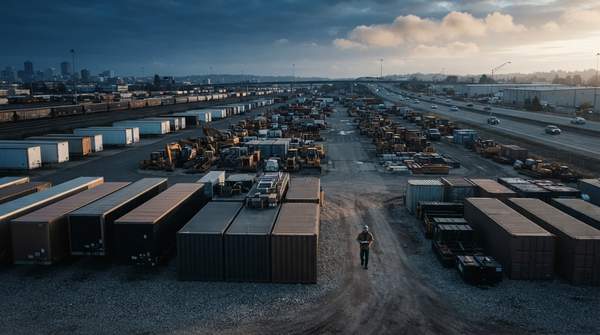
Industrial Outdoor Storage (IOS) has moved from a niche, owner-operated corner of commercial real estate into an asset class that now attracts Brookfield and Blackstone. The core investment thesis is a supply-demand imbalance: tenant demand for fleet parking and material staging keeps rising while new supply of outdoor storage yards is effectively blocked by zoning resistance and prohibitive development economics. For affluent individual investors, the opportunity is not in competing with institutions on large portfolios but in applying a structured evaluation framework to smaller lots—typically three to five acres—where local knowledge still confers an edge. This guide explains what IOS is, why the market is moving, and how to evaluate a specific property against evidence-based criteria before committing capital.
Understanding Industrial Outdoor Storage (IOS)
IOS properties are parcels of land used for the outside storage, parking, and sometimes on-site repair of tractor-trailers, large equipment such as construction or farm machinery, and building and landscape materials, as described by Anne Cosgrove writing in Business Facilities Magazine from an industry-accepted definition of the term. These properties function as mission-critical components of the supply chain: the yards where trucks park between runs, where materials are staged, and where equipment sits ready for the next job.
Two features distinguish IOS from conventional industrial real estate. First, the improvements are minimal—the value sits in the land and its entitlements rather than in buildings, which lowers capital requirements relative to warehouse development. Second, the zoning is everything. CBRE, which maintains a specialty group focused exclusively on these properties, emphasizes the complexity of their zoning and entitlement requirements as the defining technical challenge of the asset class. A parcel that is legally permitted to store heavy equipment outdoors is not interchangeable with a similar-looking parcel that is not.
The sector also remains fragmented. LaSalle Investment Management notes that institutional investment has accelerated in recent years, but overall ownership remains fragmented with a still-limited institutional footprint—commonly estimated at roughly $200 billion in aggregate market value in the U.S., though LaSalle cautions the source and scope of that figure are unclear. Many properties are still owned by small operators who may lack capital for improvements or succession plans, which is what creates acquisition and sale-leaseback opportunities for patient buyers.
Market Forces Driving IOS Investment Growth
The defining dynamic is what Hanson Capital calls a "supply cliff": tenant demand for fleet parking and material staging is rising sharply while new supply is effectively zero. Their analysis identifies two structural reasons. New heavy-industrial zoning is rarely granted—municipalities remain fiercely resistant—so you can almost never "create" new industrial-zoned land in core urban centers, even though you can always build more warehouses. And the development math for new IOS is financially unfeasible, because it would require acquiring full-coverage sites only to demolish the existing structures.
The demand side is broad rather than niche. Hanson Capital's criteria for strong markets point to deep trucking, logistics, construction, and utility activity, supplemented by interstates, ports, rail and intermodal facilities, and distribution clusters. Existing supply is also shrinking independently of new construction, as existing sites are rezoned or redeveloped toward higher and better uses.
This imbalance shows up in pricing. Hamilton Lane reports that IOS rents have increased by nearly 30 percent on average since the end of 2019, and that IOS assets typically trade at a 100 to 250 basis point yield spread over traditional industrial assets. Hamilton Lane attributes this premium to several factors, including limited competition from large investors and the ability to buy off-market from unsophisticated sellers. Because entry yields are high and rental growth strong, a large component of IOS returns comes from income rather than appreciation—structurally different from the appreciation-driven returns investors may expect from other real estate classes.
Institutional capital's arrival is a double signal. It validates the asset class and provides exit liquidity for aggregators, but it also compresses the window in which smaller investors can source off-market deals. CNBC reports that local investors can still find opportunities, especially in lots of three to five acres, in a market where rents have doubled since 2020.
IOS Investment Evaluation Checklist: A Decision Framework
The framework below synthesizes the criteria that real estate advisory firms and investment managers consistently identify as the determinants of a strong IOS investment. Use it to score a target property criterion by criterion: a property that fails on zoning legality or site viability is a red-flag deal regardless of how well it scores elsewhere.
| Criterion | What a strong investment looks like | Red flag / failure signal |
|---|---|---|
| Supply constraint | Downzoning pressure, outdoor-storage bans, and shrinking usable yard inventory in the market—rival yards cannot easily be created or replaced | Market where new competing yards are easily entitled and built |
| Demand drivers | Deep trucking, logistics, construction, and utility activity in the local economy | Dependence on a single tenant category vulnerable to an industry-specific slowdown |
| Freight infrastructure access | Proximity to seaports, intermodal hubs, airports, and major highways—properties near these command premium rents because they reduce tenant transportation costs | Location whose access does not match the target tenant's use case |
| Zoning friendliness | Carefully verified permitted uses under current local laws, rules, and regulations, with any imposed site conditions understood | Income that depends on illegal or non-conforming use the jurisdiction could shut down |
| Site characteristics | Surfaces viable for heavy loads—ideally concrete, or gravel over pavement—with proper drainage and suitable soil composition | Surface quality, topography, drainage, or soil that cannot support heavy equipment |
| Rent trend and income benchmark | Rising rent per acre and tightening vacancy; income assessed on price per usable acre rather than gross acreage, with tenant demand and turnover analyzed site by site | Flat or falling rents priced off gross acreage without usable-area analysis |
| Liquidity / buyer depth | Active institutional and private buyer interest, supporting eventual exit; aggregation of $10 million or more in assets can command a portfolio premium from institutional buyers | Thin local buyer pool with no aggregation path |
Two rows deserve emphasis. Location is the most critical determinant of value in IOS, as Northmarq's guide puts it—but "location" is use-case specific: logistics tenants prioritize transportation network access, while construction-related tenants value proximity to job sites and customer bases. And the income benchmark matters more than in building-based real estate: usable acreage, not gross acreage, is the accurate basis for comparing income potential across candidate properties.
Key Risks and Due Diligence for IOS Properties
The single most consequential risk in IOS is regulatory, and it has a specific legal shape. Because the market's growth has generated additional county and municipal regulation, an IOS use or property characteristic often predates the current zoning ordinance. That produces "legal nonconforming" status—uses that were allowed when they began but are not currently permitted, and which may be continued only subject to the specific requirements of the applicable zoning ordinance. A property whose income depends on such a use carries a shutdown risk that the local jurisdiction can exercise, and it is the clearest red flag in the framework above.
The practical mitigation is verification rather than assumption. Before purchase, confirm that the jurisdiction will actually permit IOS uses on the site and ascertain any conditions it may impose, since ordinances vary by county and city. Evaluate tenant demand and turnover site by site rather than assuming market averages carry over. Test the physical asset the way a tenant would: heavy equipment loads require surfaces that will not fail, drainage that will not flood the yard, and soil that will bear the weight.
Market concentration is a quieter risk. Tenant diversity protects income from industry-specific slowdowns—one market observer cited to CNBC notes that in Chicago, no single user category accounts for more than 18 percent of IOS tenants, insulating that market from a downturn in any one industry. An investor evaluating a property whose rent roll is dominated by one sector should treat that concentration as a discount factor, not a neutral fact.
Making an Informed IOS Investment Decision
Affluent investors should consider Industrial Outdoor Storage as a viable alternative real estate asset class, provided they conduct rigorous due diligence using a structured evaluation framework rather than buying on market momentum. The economics that make it attractive—constrained supply, rising rents, and a 100 to 250 basis point yield premium over traditional industrial, with most returns derived from current income—are property-specific and contingent on zoning that holds up under review.
A strong observable signal for a promising IOS investment is a property that aligns with high demand drivers such as logistics and construction activity, sits strategically near major transportation infrastructure, possesses zoning that clearly permits outdoor storage, and has site characteristics suited to heavy equipment. An investor who works the checklist criterion by criterion—and walks away from any deal whose income depends on a non-conforming use—has a repeatable way to compare candidate properties and identify deal-breakers before capital is committed. This guide is for informational purposes only, is based on the U.S. market as reflected in the source material, and does not constitute financial or real estate investment advice.
Sources
- Investing In Industrial Outdoor Storage? - Economic Development News - Business Facilities Magazine
- CBRE
- ISA Briefing: The emergence of land-driven logistics real estate - LaSalle Investment Management
- Industrial Outdoor Storage Institutional Advantage — Hanson Capital
- Real Estate: U.S. Industrial Outdoor Storage — Hamilton Lane
- Rising rents draw Wall Street money to industrial outdoor storage lot investments across the U.S. — CNBC
- A comprehensive guide to industrial outdoor storage — Northmarq