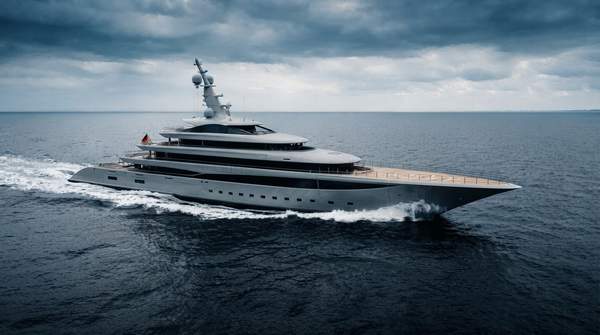
The quietest superyachts are not built quiet by adding insulation at the end. They are engineered that way from the first lines of the general arrangement, using two complementary families of technology. Passive systems — insulation, resilient mounts, hull shaping — physically block and absorb noise and vibration across a broad frequency range. Active systems generate electronically produced anti-phase sound waves that cancel specific low-frequency noise, such as engine hum and propeller cavitation, exactly where passive methods struggle. Neither approach alone is sufficient, and both must be planned into the vessel from the outset rather than retrofitted.
Passive Noise and Vibration Control: The Foundation of Quiet Design
Passive control is the discipline of interrupting the paths along which energy travels. Noise and vibration reach a guest saloon in two ways: through the air and through the structure. Machinery forces can reach accommodation spaces and remote structure through rigid foundations even when airborne machinery noise is well contained, as a superyacht engineering guide on resilient mounting explains. This is why the passive toolkit operates on both transmission routes at once.
Engine rooms are now equipped with multi-layered insulation to block mechanical noise from reaching living spaces, while vibration-dampening systems — including flexible engine mounts and couplings — reduce the transfer of vibrations through the hull. Industry coverage of noise-reduction technology in luxury yachts also points to hull designs that have evolved with optimised shapes and materials to minimise hydrodynamic noise before it is ever generated.
The core mechanism is controlled compliance. Resilient mounts introduce compliance between the machine and the supporting structure so that less dynamic force is transmitted. As the engineering guide puts it, the mount is part of the yacht's vibro-acoustic system rather than simply a support carrying machinery weight. The mount manufacturer VULKAN, for example, uses highly elastic marine mounts for engines, generators, electric motors, compressors and related equipment — a reminder that every significant machine on board, not just the main engines, is part of the acoustic problem.
Mount design involves deliberate trade-offs between isolation and control. AMC Mecanocaucho describes how higher longitudinal stiffness helps control movement generated by propeller thrust, while lateral stiffness is optimised to reduce vibration transmission to the vessel structure. Its isolators also incorporate a fail-safe feature that limits excessive movement and mechanically retains the engine under severe loads, with corrosion protection suited to demanding marine environments. Similarly, Barry Controls marine mounts — designed for engines up to, but not limited to, 1,000 hp — are engineered to isolate vibration while transmitting full propeller thrust, keeping engine noise and vibration out of the hull.
The stakes of getting this wrong extend beyond comfort. Rubberdesign, a supplier of anti-vibration solutions for marine and industrial systems, warns that when vibration is not properly isolated, it may lead to excessive noise, fatigue damage, premature component wear and reduced performance of sensitive equipment — which is why anti-vibration engineering is an important discipline within shipbuilding.