Gaetano Pesce, a visionary Italian designer, consistently challenged conventional design principles throughout his remarkable career by integrating experimental materials, distinctive sculptural forms, and profound social commentary into his work. His approach fundamentally rejects established norms of abstraction, uniformity, and homogeneity, instead embracing individuality and a "cross-contamination" between genres that, according to Friedman Benda, significantly altered the landscape of contemporary design and catalyzed the establishment of modern studio practice. Pesce's creations are often characterized by their vibrant colors, figurative expressions, and sometimes gelatinous textures, reflecting his belief that design should be pliable, immediate, and responsive to the contemporary world, as noted by Artspace Editors.
Pesce's commitment to using materials he considered authentic to the present moment, such as resin, foam, and urethane, allowed him to be sincere in his designs. He viewed materials from the past, like metal, marble, and stone, as "fake" because they no longer represented current reality, as he explained in an interview with Sight Unseen. This philosophy underpins his most iconic works, where material innovation is not merely a stylistic choice but is intrinsically linked to their sculptural expression and underlying critical messages, inviting users into a dialogue with their furniture.
UP5/La Mamma: Material Innovation and Feminist Commentary
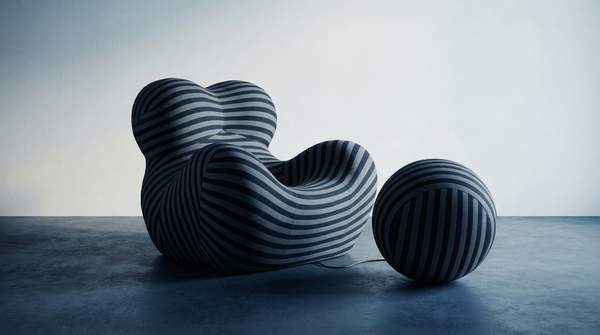
One of Gaetano Pesce's most iconic and politically charged creations is the UP5/La Mamma armchair, designed in 1969 for B&B Italia. This piece serves as a clear and powerful political statement, originally conceived by Pesce to resemble an ancient fertility figure, as Andrea Carson Barker notes for Azure Magazine. The chair, with its generous, rounded, and anthropomorphic shapes, is accompanied by a ball-shaped ottoman. Together, the chair and its attached ottoman function as a profound feminist statement, symbolizing the global condition of women and motherhood, with the ottoman representing societal constraints, akin to a ball and chain, according to Francesco Colbachini writing for Italian Design Club.
The UP5/La Mamma chair is ingeniously constructed from polyurethane foam and covered in elastic fabric. This innovative material choice allows the chair to be compressed and vacuum-packed for shipping, a revolutionary concept at the time. Upon opening, the chair slowly expands to regain its full, voluminous shape, embodying the pop-art spirit of its era through both its form and its interactive, almost performative, unboxing experience. The pliability and expansive nature of the polyurethane foam are crucial to both its distinctive sculptural form and its practical, transportable design, directly linking material properties to its conceptual message of liberation and expansion from constraint.